


Cell Biology
The Cell Biology Platform supports the Institute’s research teams in all methodological aspects related to the biology of human pluripotent stem cells and their derivatives. In particular, we are responsible for the quality control of these cells to ensure their identity and stability throughout experimental procedures. In addition, the platform contributes, whenever required, to the optimization of culture conditions and associated processes, with the aim of ensuring robustness, reproducibility, and reliability of the results obtained.
Contact: kgiraudtriboult[AT]istem.fr

Quality control is a crucial and decisive factor for the appropriate use of human pluripotent stem cells and their derivatives. At I-Stem, we pay particular attention to this area of investigation, as undetected cellular abnormalities may lead to major errors in disease modeling and pharmacological studies or introduce significant safety risks in the context of cell therapy. For this reason, our team performs systematic and regular quality assessments of all cell lines generated within the Institute.
Karyotyping is used to detect chromosomal abnormalities ranging in size from approximately 5 to 10 Mb (megabases). This approach enables the identification of both balanced structural abnormalities, such as reciprocal translocations, and numerical chromosomal abnormalities, including trisomy and monosomy. To achieve this, we use conventional cytogenetic techniques, including G-banding and R-banding, as well as multicolor Fluorescence In Situ Hybridization (mFISH), allowing a comprehensive and accurate characterization of the cellular genome.
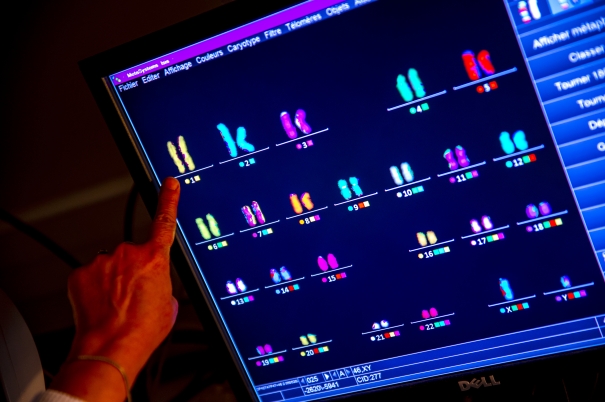
Thanks to a high-performance cytogenetics infrastructure, including a CDS-5 thermostatically controlled drying chamber (Thermotron) and a Metasystems automated microscopy platform, the team can generate high-quality karyotypes. These tools provide detailed chromosome analyses, facilitating the precise identification of chromosomal breakpoints and the characterization of complex chromosomal rearrangements.
We also perform routine genomic analyses using Illumina Single Nucleotide Polymorphism (SNP) arrays, commercialized by Integragen (Evry, France). This approach enables the detection and precise mapping of genomic abnormalities in human pluripotent stem cells and their derivatives, with a resolution of up to 100 kilobases, thereby providing a detailed assessment of their genetic integrity.
To further improve the assessment of genomic integrity, the platform maintains an active technology watch and continuously evaluates emerging detection methods. Through our collaboration with StemGenomics (Montpellier, France), we have access to a rapid screening assay capable of detecting the most frequently acquired genetic abnormalities in pluripotent stem cells. This tool represents an essential quality control step during critical activities, such as the generation of large-scale cell banks by the Bioproduction Platform or genome-editing procedures using CRISPR/Cas9 technology, thereby ensuring the integrity of the cells employed in these processes.
Over the past several years, the team has developed recognized expertise in these areas. Notable projects have included the investigation of immune-evasion mechanisms (“ghost cells”) in collaboration with the team of Thierry Heidmann, the company Viroxis, and the CR2TI research center in Nantes. The team has also participated in the MyoPharm program, through which I-Stem collaborated with several French research groups to develop innovative therapeutic approaches for ultra-rare neuromuscular disorders.
The platform also provides its expertise to academic and industrial partners through genetic and cytogenetic testing services, including karyotyping by G/R-banding and mFISH, as well as SNP-array analyses for the high-resolution detection of chromosomal abnormalities.
ANR AAPG 2021 – PRCE: Ghosting The Cells (GTC):
Research project focused on the generation of “ghost” cells that preserve normal HLA antigen presentation mechanisms while reducing immune recognition through the membrane display of a retrovirus-derived immunosuppressive molecule.
Team members
Karine Giraud-Triboult
Platform Manager (CECS)
Karine is a Functional Genomics Engineer. She joined the team at I-Stem’s creation in January 2005, working on the DM1 project. She has headed the Cell Biology Platform since 2017.
Lina El Kassar
Platform Engineer (CECS)
Lina has a PhD in Biology. She joined the team at I-Stem’s creation in January 2005, working on the DM1 project. She led the iPS workshop for three years, and since 2016 has been in charge of monitoring the genomic integrity of cells at I-Stem.
Hamel Mahiou
Technician (CECS)
Hamel joined the team at the end of 2022 as a work-study student. After obtaining her professional degree in biotechnology, she joined the team as a platform technician. She provides support for all team and laboratory projects, particularly in cell culture and quality control.
Collaborations
Specialist in the biology of infectious and endogenous retroviruses, and more particularly in the molecular basis of their induction of immunosuppression.
Specialist in immunology at VIROXIS which develops immunosuppressive molecules derived from retroviral proteins for transplant applications.
Scientific leader of the humanized rodents platform of LabEx IGO, which focuses on the development of strategies to control the immune response.
– INSERM, Centre de Recherche en Myologie, Sorbonne Université, UMRS974, INSERM, Institut de Myologie-Faculté de Médecine de la Pitié Salpêtrière, Antoine Muchir
– CNRS UMR 5310 – INSERM U1217, Institut NeuroMyoGène, Université de Lyon, Arnaud Jacquier, Laurent Shaeffer
– INSERM U955 IMRB UPEC, Créteil, Frederic Relaix
– INSERM U1251, Marseille Medical Genetics, Valérie Delague
Publications
Generation and characterization of three human induced pluripotent stem cell lines from patients with Duchenne muscular dystrophy.
01 September 2026
Stem cell research
Integrative analysis of drug-gene signatures in human pluripotent stem cells reveals prazosin as a novel SQSTM1 regulator for ALS therapeutics.
14 July 2026
Stem cell reports
Generation of two iPSC lines each carrying a stop codon mutation, c.366T > A (p.Y122X) and c.1657C > T (p.R553X), in the CFTR gene from the parental line PCIi033-A using CRISPR/Cas9.
01 August 2026
Stem cell research
MAGNETAPURE 32+
Automated platform for magnetic bead-based DNA/RNA extraction
Thermotron
Thermostatically controlled drying chamber CDS-5
Metasystem
Automated microscopy station. The exact location of chromosome breakpoints, karyotypes and chromosome classification are obtained with Isis and Ikaros software.